Last Updated on 8. October 2026 by SuffocationLink status: OK
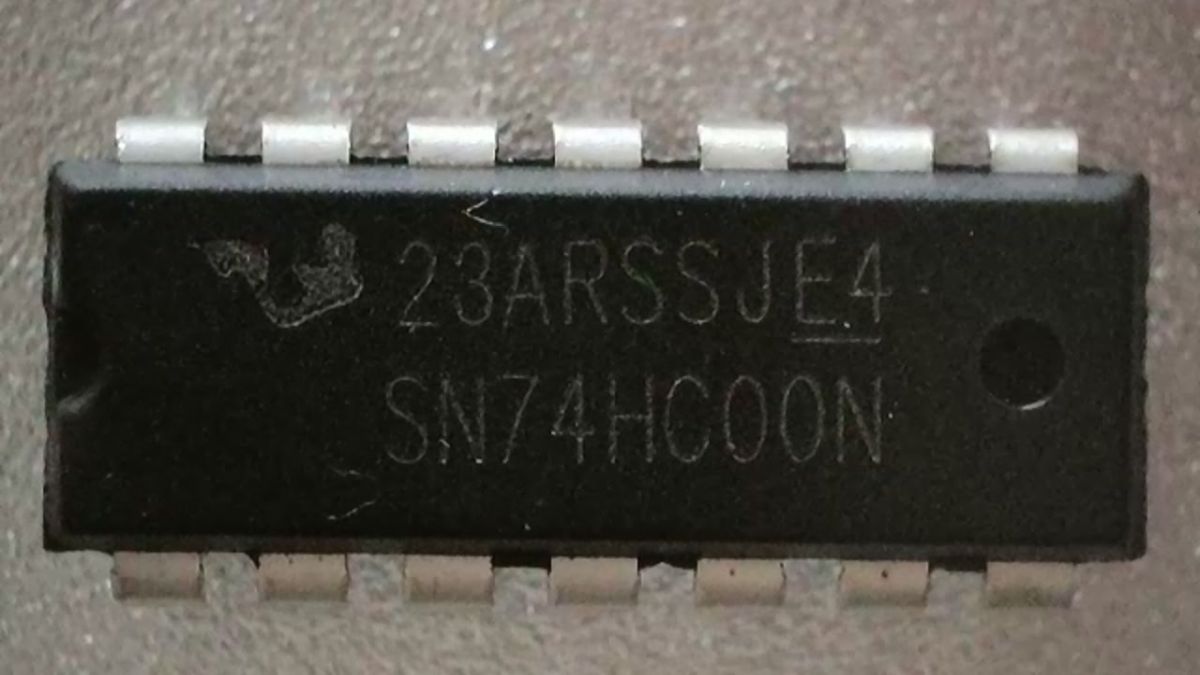
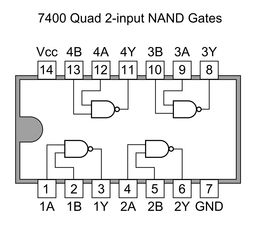
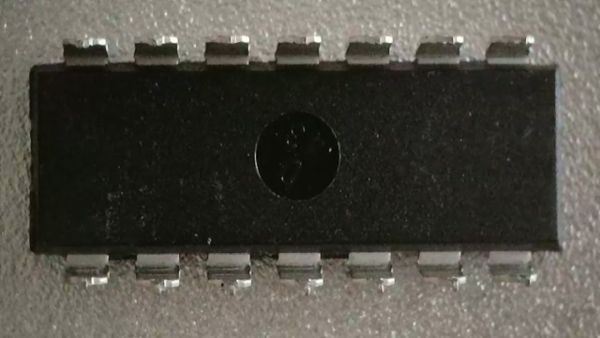
Vier Nand Gatter in einem IC. Mit dem ersten IC der TTL Serie, können weitere Grundschaltungen erstellt werden, so dass man nur eine Art von IC bräuchte. Dies machte das IC so vielfältig und beliebt in seiner Zeit. Leider ist die Zeit der TTL Bausteine vorüber, heute werden mehr diese meist durch kleine Controller ersetzt, die mit Software programmiert, komplexe Logiken abbilden können. Dennoch leitet dieser Baustein auch meine TTL Serie ein. Die Verwendung der Bausteine dient dem besseren Grundverständnis, was als Basis für komplexere Schaltungen oder auch für die Programmierung hilfreich ist. Auch ist nicht auszuschließen, dass solch ein Baustein einmal seine Anwendung mit einem Microcontroller findet, um beispielsweise weniger GPIOs zu benötigen. (Beispiel ODER Schaltung zweier Kollisions-Taster. Sobald einer gedrückt ist, besteht eine Kollision, es wird aber nur ein GPIO benötigt (Ich weiß geht auch ohne Baustein 😉 ).
Was ist ein TTL IC?Link status: OK
Facts
NAND symbol

Schematic
Truth table
NAND gate
| # | 1/2/3/4 A | 1/2/3/4 B | 1/2/3/4 Y | Explanation |
|---|---|---|---|---|
| 1 | 0 | 0 | 1 | Both inputs LOW => output HIGH |
| 2 | 1 | 0 | 1 | Input A HIGH, B LOW => Output remains HIGH |
| 3 | 0 | 1 | 1 | Input A to LOW, B to HIGH => Output remains HIGH |
| 4 | 1 | 1 | 0 | Both inputs HIGH => output LOW, only LOW state |
Logic tester
Data sheet
https://www.ti.com/product/de-de/SN7400Link status: OK
Areas of application
- Activation of ICs via bus address
- Input Control
- Logical sequences
Views
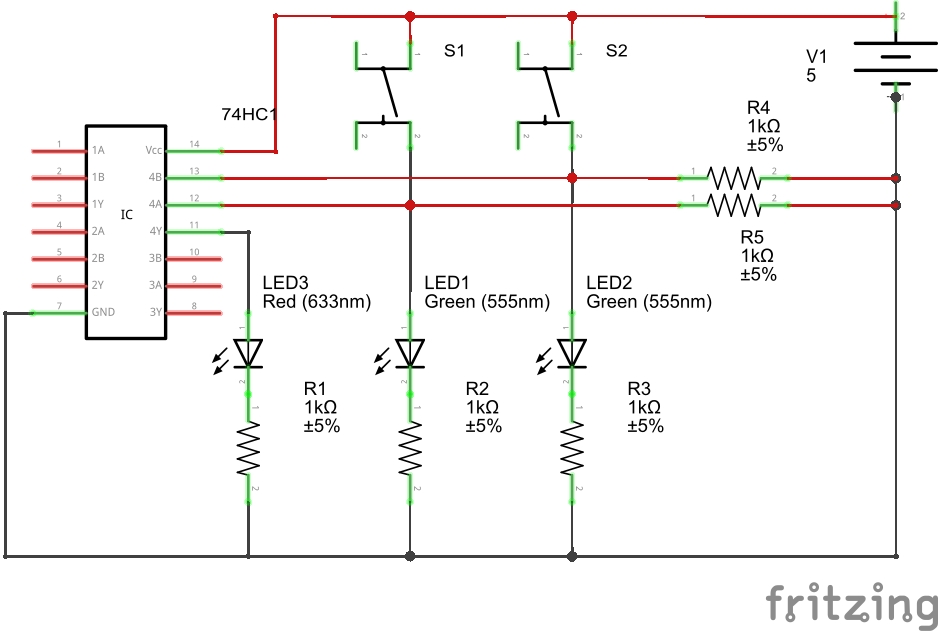
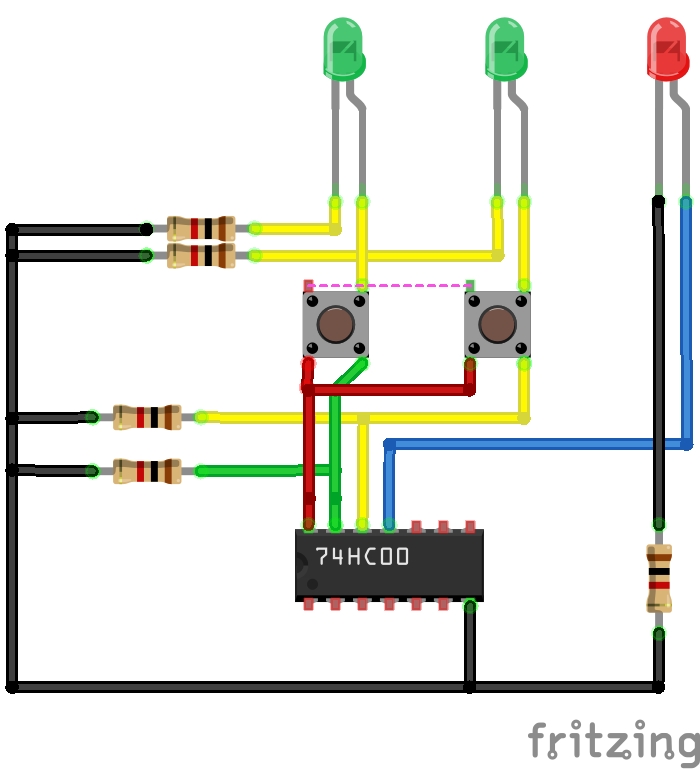
Circuit
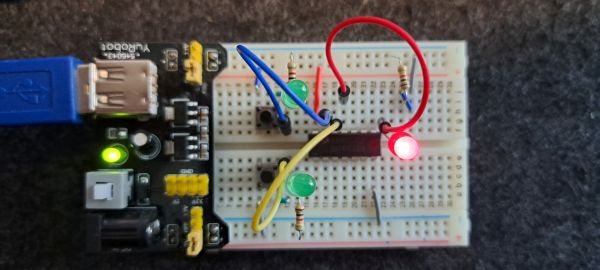
Test
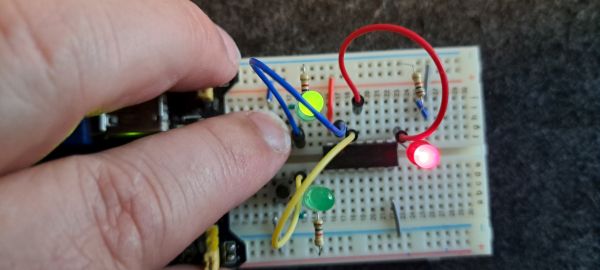
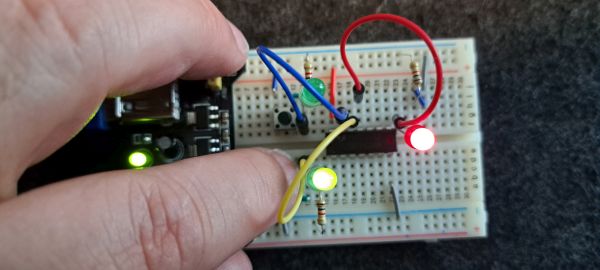
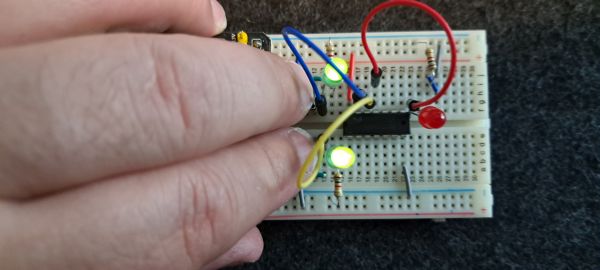
Programme
/** AND function */
bool and(bool e1, bool e2) {
    return e1 && e2;
}

/** Not a function */
bool not(bool e1){
  return !e1;
}

/** NAND-funktion */
bool nand(bool e1, bool e2){
  return not (e1 and e2);
}

void main(){
  bool output1 = nand(true, true);
  bool output2 = not(and(true, true));
  // do some output
}
Problems
Im Ruhezustand ist die rote LED aus
Nicht alle ICs ziehen automatisch die Eingänge auf Masse, um das Problem zu beheben, müssen Pulldown-Widerstände zwischen dem Eingang und Masse geschaltet werden. 1kOhm ist OK, kann auch mehr sein.
Miscellaneous
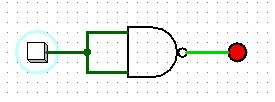
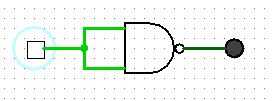
NOT circuit
Für eine Not Schaltung werden zwei Eingänge eines NAND Gatters verbunden. Zum Beispiel verbindet man Pin 12 und 13, das an 12 anliegende Eingangssignal wird dann invertiert am Ausgang ausgegeben.
| # | Input A (12) | B (13) | Exit Z | |
|---|---|---|---|---|
| 1 | 1 | =A | 0 | Input to HIGH is inverted to output (LOW) |
| 2 | 0 | =A | 1 | The input on LOW is also inverted to the output (HIGH). |
AND circuit
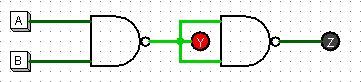
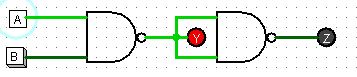
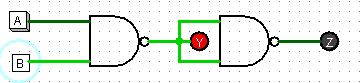
Für die AND Schaltung werden zwei Gatter benötigt, eins als NAND und eins als NOT beschaltet.
| # | A | B | C | D | Explanation |
|---|---|---|---|---|---|
| 1 | 0 | 0 | 1 | 0 | Both inputs on LOW, output is also LOW |
| 2 | 1 | 0 | 1 | 0 | Input A HIGH, B LOW, Output LOW |
| 3 | 0 | 1 | 1 | 0 | Input A to LOW, B to HIGH, Output LOW |
| 4 | 1 | 1 | 0 | 1 | Both inputs high, therefore the output is high |
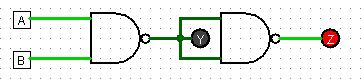
OR circuit
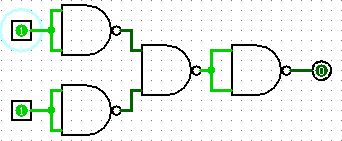
Die Or Schaltung benötigt schon drei Gatter. Der Ausgang ist HIGH, sobald einer der Eingänge auf HIGH gelegt wird.
| # | A | B | A | !B | Z | |
|---|---|---|---|---|---|---|
| 1 | 0 | 0 | 1 | 1 | 0 | Both inputs low, output low |
| 2 | 1 | 0 | 0 | 1 | 1 | Input A to HIGH and B to LOW, output to HIGH |
| 3 | 0 | 1 | 1 | 0 | 1 | Input A to LOW and B to HIGH, output to HIGH |
| 4 | 1 | 1 | 0 | 0 | 1 | Both inputs to HIGH, output to HIGH |
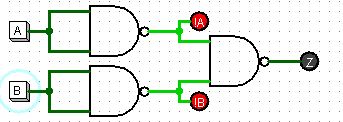
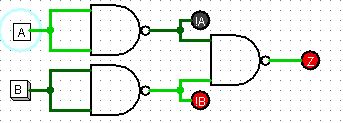
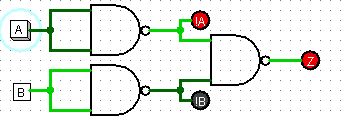
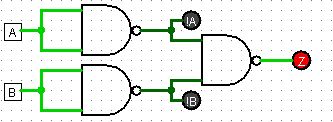
OR gate
Natürlich ist auch ein NOR-Gatter Schaltung möglich. Hierfür muss ein weiteres Gatter hinzugefügt werden, um den Ausgang zu negieren. Ist einer der Eingänge auf HIGH, ist der Ausgang immer LOW
| # | A | B | A | !B | Z | Explanation |
|---|---|---|---|---|---|---|
| 1 | 0 | 0 | 1 | 1 | 1 | Beide Eingänge auf LOW, der Ausgang ist HIGH |
| 2 | 1 | 0 | 0 | 1 | 0 | Input A to HIGH and B to LOW, output to LOW |
| 3 | 0 | 1 | 1 | 0 | 0 | Input A to LOW and B to HIGH, Output to LOW |
| 4 | 1 | 1 | 0 | 0 | 0 | Beide Eingänge auf HIGH, der Ausgang ist LOW |
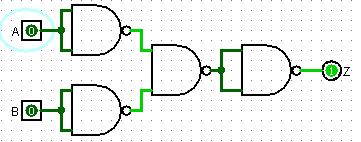
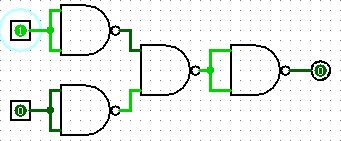
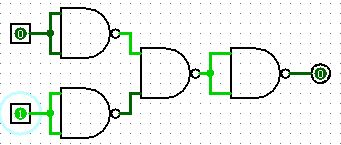
RS-FlipFlop
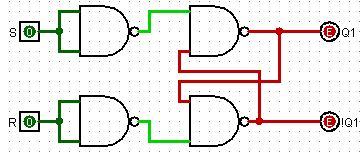
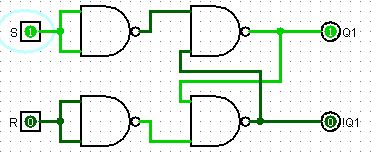
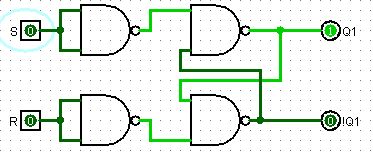
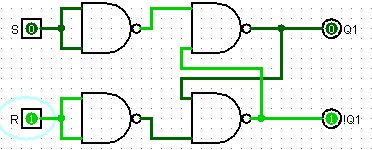
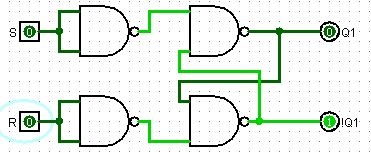
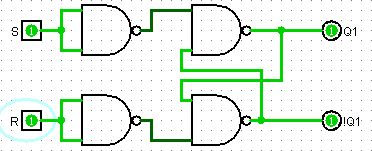
Mit den 4 Gattern des 7400 lässt sich auch ein RS-FlipFlop aufbauen. Der S(ets) und R(eset) Eingang müssen negiert werden und die Ausgänge jeweils auf einen Eingang rückgekoppelt werden. In der Simulation haben die Ausgänge initial einen undefinierten Zustand. In der Realität ist es entweder gesetzt oder zurückgesetzt. Das Interessante am RS Flipflop ist, dass der Zustand nach Lösen des S-Tasters erhalten bleibt und erst wieder mit Betätigung des R-Tasters zurückgesetzt wird. Somit können wir 1 Bit speichern.
Durch die Rückkopplung muss immer der Vorgänger Zustand mit betrachtet werden. Zum Beispiel wurde Set auf HIGH gesetzt und dann wieder auf LOW, bleibt Q1 HIGH.
| # | S | R | !S | !R | Q1 | !Q1 | Explanation |
|---|---|---|---|---|---|---|---|
| 1 | 0 | 0 | 1 | 1 | * | * | Initial state |
| 2 | 1 | 0 | 0 | 1 | 1 | 0 | Set to HIGH |
| 3 | 0 | 0 | 1 | 1 | 1 | 0 | Set saved |
| 4 | 0 | 1 | 1 | 0 | 0 | 1 | Reset auf HIGH |
| 5 | 0 | 0 | 1 | 1 | 0 | 1 | Reset saved |
| 6 | 1 | 1 | 0 | 0 | 1 | 1 | Unacceptable condition |
| 7 | 0 | 1 | 1 | 0 | 0 | 1 | Reset wird gewählt |
| 8 | 0 | 0 | 1 | 1 | 0 | 1 | Reset saved |
| 9 | 1 | 1 | 0 | 0 | 1 | 1 | Unacceptable condition (2) |
| 10 | 1 | 0 | 0 | 1 | 1 | 0 | The set is chosen |
| 11 | 0 | 0 | 1 | 1 | 1 | 0 | Zustand gespeichert |
Zustand 6, beide Eingänge auf HIGH, ist unzulässig. Der weitere Verlauf hängt davon ab, welcher der beiden Eingänge zuerst auf LOW gesetzt wird. Dies führt dazu, dass der jeweils andere zählt. Wird S zuerst auf LOW gesetzt, zählt der R Eingang somit ist !Q1 aktiv. Im umgekehrten Fall wird R zuerst auf LOW gesetzt, zählt der S Eingang und Q1 ist aktiv.
XNOR
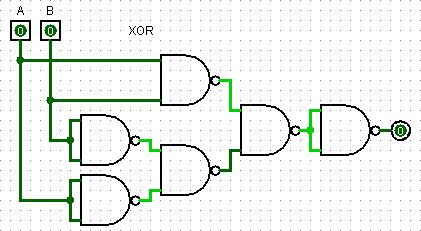
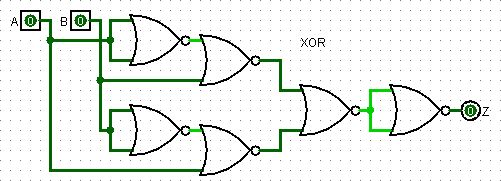
Der Ausgang ist immer HIGH, wenn die Eingänge gleiches Potential haben (A=B= LOW od. A=B=HIGH). Für diese Schaltung benötigt man mehr als nur ein IC.
| # | A | B | A | !B | C | D |
|---|---|---|---|---|---|---|
| 1 | 0 | 0 | 1 | 1 | 1 | 1 |
| 2 | 1 | 0 | 0 | 1 | 1 | 0 |
| 3 | 0 | 1 | 1 | 0 | 1 | 0 |
| 4 | 1 | 1 | 0 | 0 | 0 | 1 |
XOR
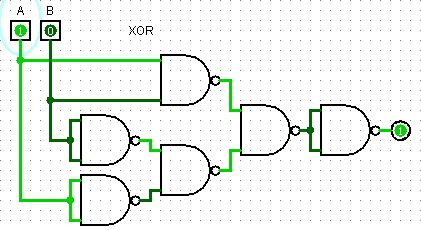
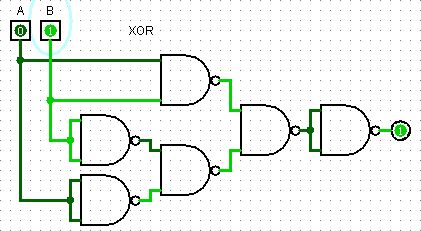
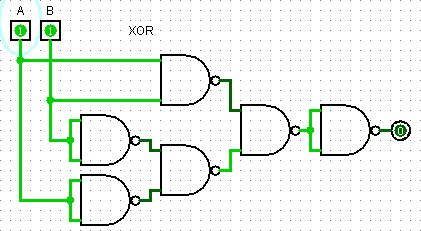
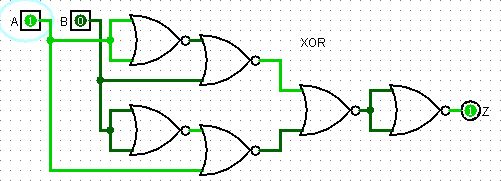
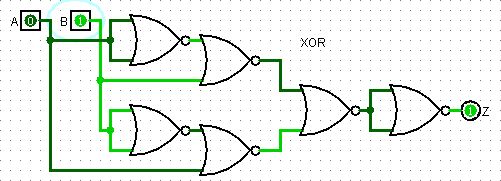
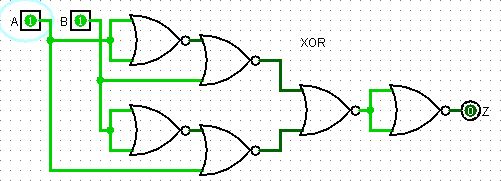
Beim XOR ist der Ausgang HIGH, wenn die Eingänge unterschiedlich sind. Für diese Schaltung benötigt man schon 1,5 ICs.
| # | A | B | A | !B | C | D |
|---|---|---|---|---|---|---|
| 1 | 0 | 0 | 1 | 0 | 1 | 0 |
| 2 | 1 | 0 | 0 | 0 | 1 | 1 |
| 3 | 0 | 1 | 1 | 1 | 1 | 1 |
| 4 | 1 | 1 | 0 | 1 | 0 | 0 |
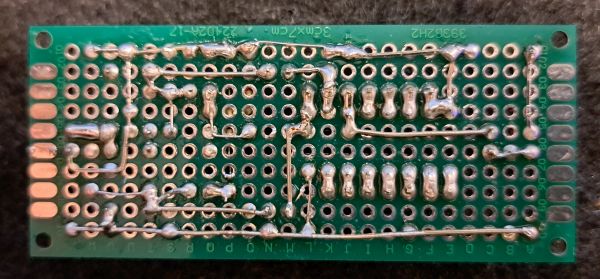
Platine gelötet
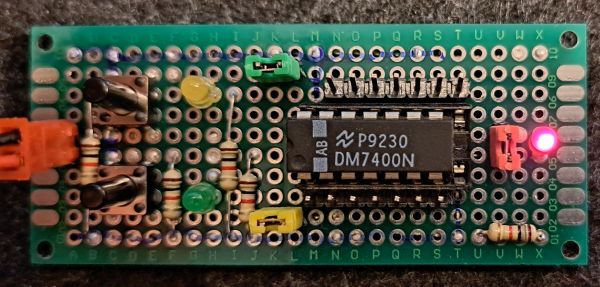
Ich bitte das Chaos auf der Platine zu entschuldigen, musste erstmal wieder Fähigkeiten abrufen, die ich Jahrzehnte nicht genutzt habe. Der Bauplan entspricht im Großen und Ganzen dem oben gezeigten. Die Jumper trennen die LEDs samt Schalter vom IC um andere Schaltungen aufbauen zu können. Ich betreibe die Platine übrigens mit 6V (4x 1,5v AAA Batterien).
Ich habe aus Versehen einen 16 Poligen IC Sockel verwendet. Auslöten war keine Option und die Brücke zur Masse wollte ich auch nicht mehr entfernen, so habe ich PIN 7 und 8 des Sockels einfach verbunden.
View
Materialliste
| Component | Number |
|---|---|
| LED Grün/Gelb/Rot (Können auch die gleiche Farbe haben) | 3 |
| Jumper (Red, Green, and Yellow correspond to the selected LED colours) | 3 |
| 2 straight Polig pins | 3 |
| 2 Polig Pins abgewinkelt für die Stromversorgung | 1 |
| 7-pin plug for additional connections | 3 |
| Buttons with long press | 2 |
| 1K Widerstand (Pulldown/Vorwiderstand für LED) | 5 |
| 14-pin IC socket | 1 |
| Silberdraht für die Verbindungen auf der Rückseite | ? |
| Solder | ? |
Addendum Wenn man die LEDs mit den Pulldownwiderständen in Reihe schaltet, kann man zwei Widerstände einsparen. Die Spannung von 3,5V (5V Versorgungsspannung -1,5V LED) am Eingang des ICs sollten ausreichen, um ein HIGH zu erzeugen.
Conclusion
A fascinating IC. Very diverse in its function. With it, by using all the gates, one can create other basic logic functions such as AND, NOR, OR, NOT, and even higher logic functions like an R/S flip-flop.
Related Posts
- TTL IC 7402Link status: OK
- TTL – Transistor Transistor Logik IC’sLink status: OK
Sources
https://de.wikipedia.org/wiki/7400Link status: OK
TTL Code DatabaseLink status: OK
https://www.elektronik-kompendium.deLink status: OK
https://sourceforge.net/projects/circuitLink status: OK (Logic Sim, I use it for my drawings)
LogiSim – SchaltungssimulatorLink status: OK
https://logigator.com/editorLink status: OK
Log
| Date | Change | Author |
|---|---|---|
| 08.10.2026 | Überschriften-Hierarchie korrigiert (H1→H2, Unterebenen eine Stufe tiefer) | Suffocation |
| 04.10.2026 | Rechtschreibung korrigiert: Tippfehler (Grundverständnis, Kollisions-Taster, Silberdraht u. a.), Groß-/Kleinschreibung und Kommasetzung | Suffocation |
| 03.10.2026 | Logbuch-Tabelle auf Log-Liste umgestellt | Suffocation |
| 01.06.2024 | XOR and XNOR added. Photos of the circuit board added. | Suffocation |
| 31.05.2024 | Added RS-FlipFlop and made a few marginal improvements. | Suffocation |
| 30.05.2024 | An RS flip-flop can be implemented using NAND gates. Board soldered. | Suffocation |
| 25.05.2024 | Live | Suffocation |
| 24.05.2024 | Error corrected and link to TTL IC inserted. Logic circuits added. | Suffocation |
| 18.05.2024 | Pictures taken, circuit assembled and tested. | Suffocation |
| 15.05.2024 | Post created | Suffocation |