Last Updated on 18. October 2026 by SuffocationLink status: OK
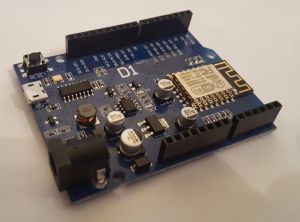
The WeMos D1 R2 ESP8266 looks like a complete Arduino Uno, apart from the number of analogue ports.
Die IOs arbeiten jedoch nur mit 3V anstatt mit den gewohnten 5V, was wohl zu Inkompatibilitäten zu den meisten Erweiterungsplatinen (Shields) führt. Der Preis liegt bei AliExpress unter 5 Euro.
Der Vorteil des D1 ist der leistungsstarke ESP8266 Chip, der eine komplette WLAN Einbindung ermöglicht.
Views
Frontansicht mit den Verbindern für Erweiterungsplatinen, dem Stromanschluss, USB Anschluss und Resettaster. Gut zu sehen ist der aufgelötete ESP 8266 rechts unten.
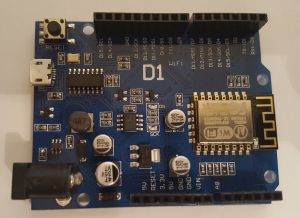
WeMos D1 R2 ESP8266 – Front 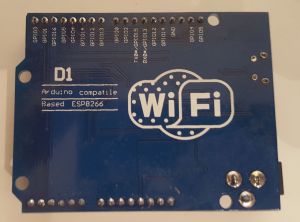
WeMos D1 R2 ESP8266 – Rückseite
Technical Data
| WeMos D1 R2 ESP8266 | |
|---|---|
| Manufacturer | WEMOS |
| Processor | ESP8266MOD |
| Kernel | 1 |
| Tact | 80 MHz |
| Flash | 4 MB |
| SRAM | 128 KB |
| Digitale Pins | 11 |
| Analoge Eingänge | 1 |
| PWM-Pins | 10 |
| UART | 1 |
| SPI | 1 |
| I²C | 1 |
| WLAN | 2,4 GHz 802.11 b/g/n · WEP / WPA2 / TKIP /AES |
| USB | 1 Micro |
| Operating voltage | 3,3 V |
| Input voltage | 7-12 V |
| Stromaufnahme | über 500 mA |
| Abmessungen | 68,6 x 53,3 mm |
| Weight | unter 25 g |
Programming
Arduino programming environment
Als Board „WeMos D1 R2 & mini“ auswählen.
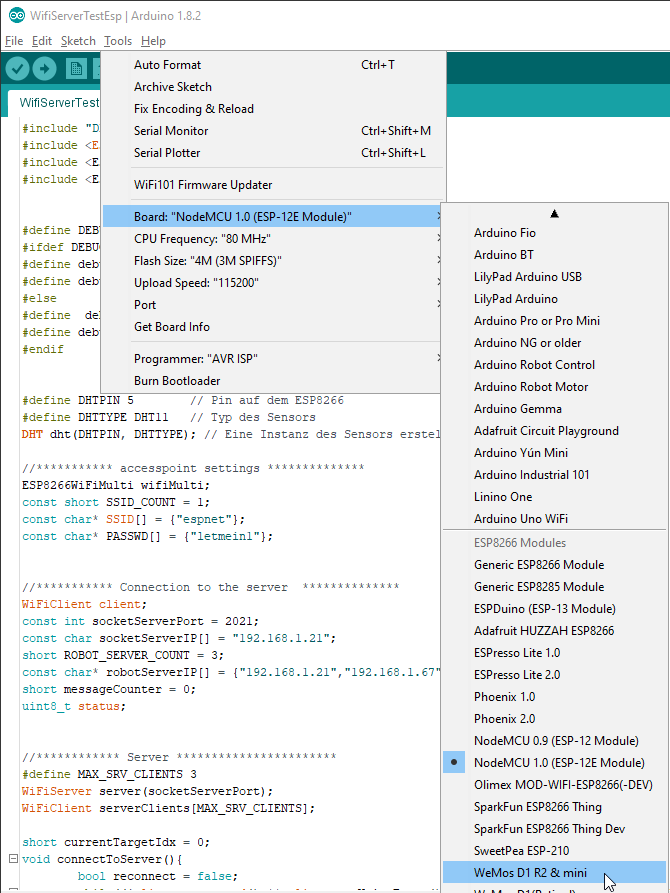
Die Boardeinstellungen sehen bei mir wie folgt aus:
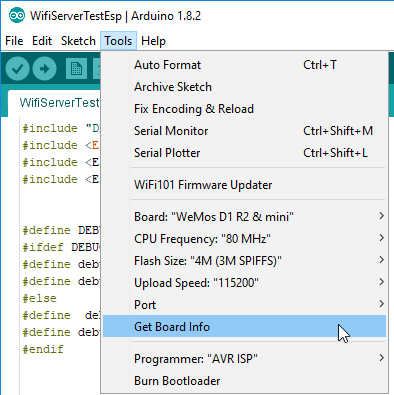
I just had to adjust the transmission speed to 115200 and the port to my connection port to the board.
Miscellaneous
Working expansion boards
Prototype Board V1
Ist kompatibel mit ein paar Einschränkungen:
- Nur 1 analoger Port
- IOs mit 3V anstatt 5 V
Motor board V2
Sensor board V5
Conclusion
Der D1 ist leider nur bedingt kompatibel. Wer aber einen günstigen Arduino mit WLAN Zugang sucht und nur wenige Ports benötigt, ist mit dieser Variante ganz gut bedient.
Sources
| Date | Change | Author |
|---|---|---|
| 18.10.2026 | TablePress-Tabelle durch Datenblock aus dem Modell ersetzt | Suffocation |
| 08.10.2026 | Überschriften-Hierarchie korrigiert (H1→H2, Unterebenen eine Stufe tiefer) | Suffocation |
| 04.10.2026 | Rechtschreibung korrigiert: Tippfehler, Kommas, Groß-/Kleinschreibung | Suffocation |
| 03.10.2026 | Log-Liste eingefügt | Suffocation |
| 19.03.2018 | Post created | Suffocation |
Wemos D1R2 different variants
I recently bought a larger quantity of this board for a project with young people.
It was not possible to upload a program to 3 of these models.
Upon closer inspection, I've found that these 3 had an SMD Zener diode (w3) directly below the CH430C chip instead of an SMD capacitor. (USB port at the top)
Here is my question:
Is this a different model/variant or is it simply an incorrect fitting?
Hello Thorsten, unfortunately I only have one or two of these models, so no comparison. A faulty part is possible, but I haven't had any issues so far. Is the ESP the same? I'd go with the non-academic method and swap them out at once. Regards, Stefan
Hello and apologies for the late reply, the comment was unfortunately lost in the spam messages.
I'm not entirely sure if I understand the question correctly. The Wemos D1 is programmable via the Arduino interface and can be used as a limited Arduino substitute. The main advantages are that the ESP on board has a WLAN chip, which can be used to access the local network. I've adjusted the article slightly in this regard.
Hello and good evening – this looks very, very interesting:
So, can I therefore connect the WEMOS D1 with an Arduino development platform – I look forward to hearing from you again.
Martin