Last Updated on 18. October 2026 by SuffocationLink status: OK
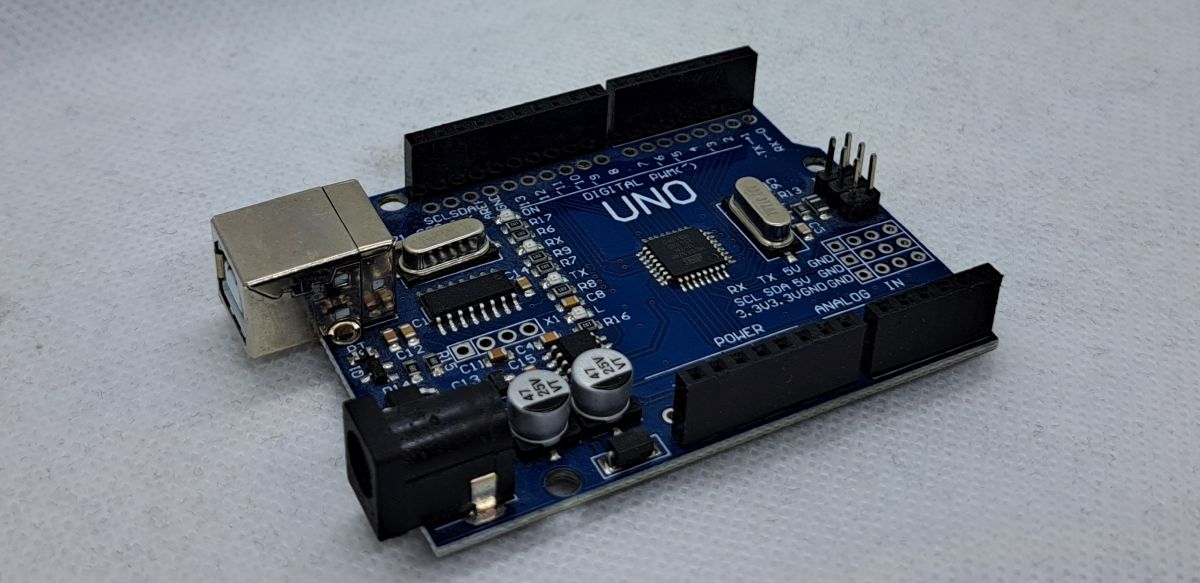
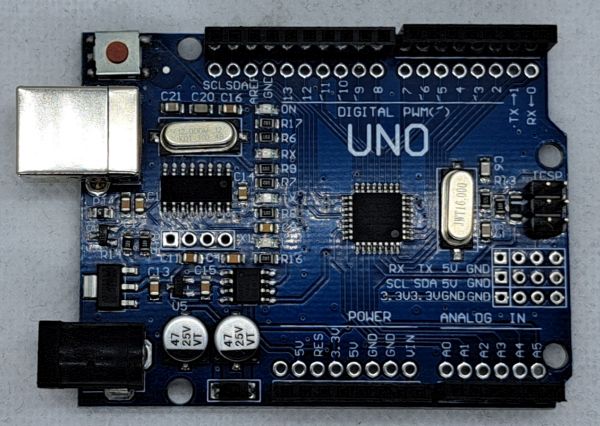
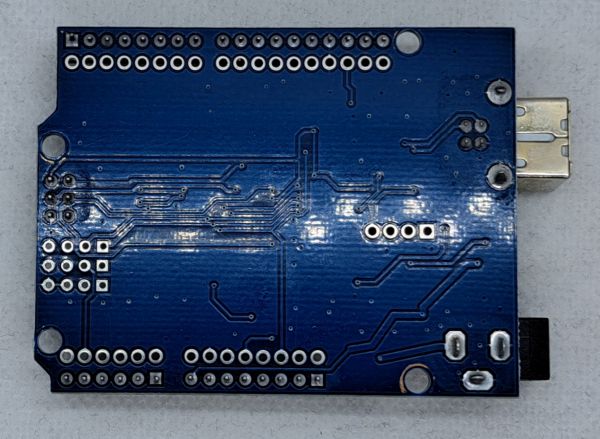
Seit 2023 ist der Uno in der Revision 4 auf dem Markt. Hier verzweigen die Modelle sich in den Minima (ähnlich dem Ur Uno) und den Wifi auf. In manchen älteren Revisionen ist der Microcontroller gesockelt, so dass er, wenn mal was schief geht, einfach ausgetauscht werden kann. Er ist das perfekte Einsteigerboard, um in die Materie der Microcontrollerprogrammierung hineinzufinden. Für Schulungszwecke ist er daher sehr gut geeignet, aber im Original leider etwas teuer. Wobei bedacht sei, dass hierdurch die Entwicklung der Entwicklungsumgebung mitfinanziert wird.
Aus meiner Sicht ist er, bis auf den R4 Wifi, nicht mehr ganz zeitgemäß, da er durch seine mangelnde W-Lan Anbindung und seinen kleinen Speicher schnell an seine Grenzen stößt. Das Internet der Dinge lechzt nach günstigen, kabellosen Kommunikationsmöglichkeiten. Hierfür sind andere Controller wie der ESP oder der Raspberry Pi Pico W besser geeignet.
Views
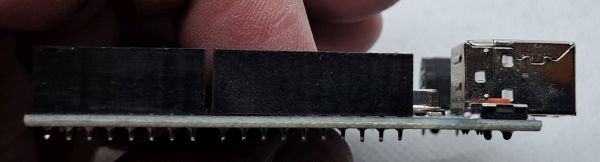
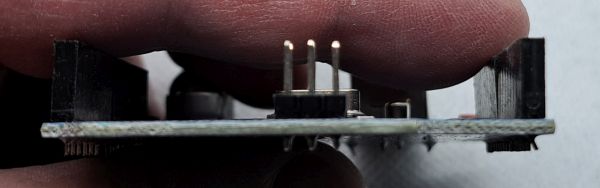
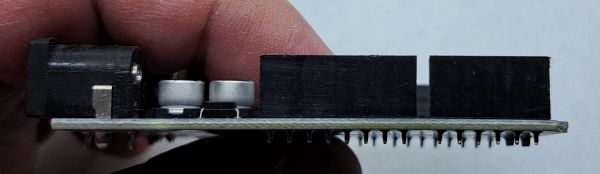
History
| Appearance | Name | Op.U | Processor | End | Some special features |
|---|---|---|---|---|---|
| 2006 | Arduino Serial | 5V | ATMEGA8 | Serial | Special features |
| 2007 | One | 5V | ATMEGA8 + ATMEGA8U2-MU | USB-B | Chip on the board, |
| 2008 | R2 | 5V | ATmega328P ATMEGA8U2-MU | USB-B | Chip um 45° gedreht, gerade auf der Platine, |
| 2010 | R3 | 5V | ATmega328PLink status: OK | USB-B | Chip gerade auf der Platine, 4 zusätzliche Pins. 2 für I2C Schnittstelle. 1 für die Referenzspannung für Zusatzplatinen, 4. ungenutzt |
| 2023 | R4-Minima | 5V | Renesas RA4M1 (Arm® Cortex®-M4) | USB-C | |
| 2023 | R4-WiFi | 5V | Renesas RA4M1 (Arm® Cortex®-M4) | USB-C | Wi-Fi / LED Matrix |
Overview
| Arduino Uno | |
|---|---|
| Manufacturer | Arduino |
| Processor | ATmega328P |
| Kernel | 1 |
| Tact | 16 MHz |
| Flash | 32 KB |
| SRAM | 2 KB |
| EEPROM | 1 KB |
| Digitale Pins | 14 |
| Analoge Eingänge | 6 |
| PWM-Pins | 6 |
| Interrupt-Pins | 2 |
| UART | 1 |
| SPI | 1 |
| I²C | 1 |
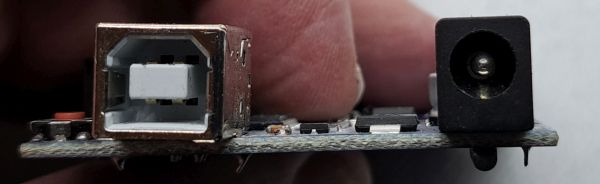
| USB | 1 USB-B |
| Operating voltage | 5 V |
| Input voltage | 7-12 V |
| Abmessungen | 68,6 x 53,4 mm |
| Weight | 25 g |
Pin assignment
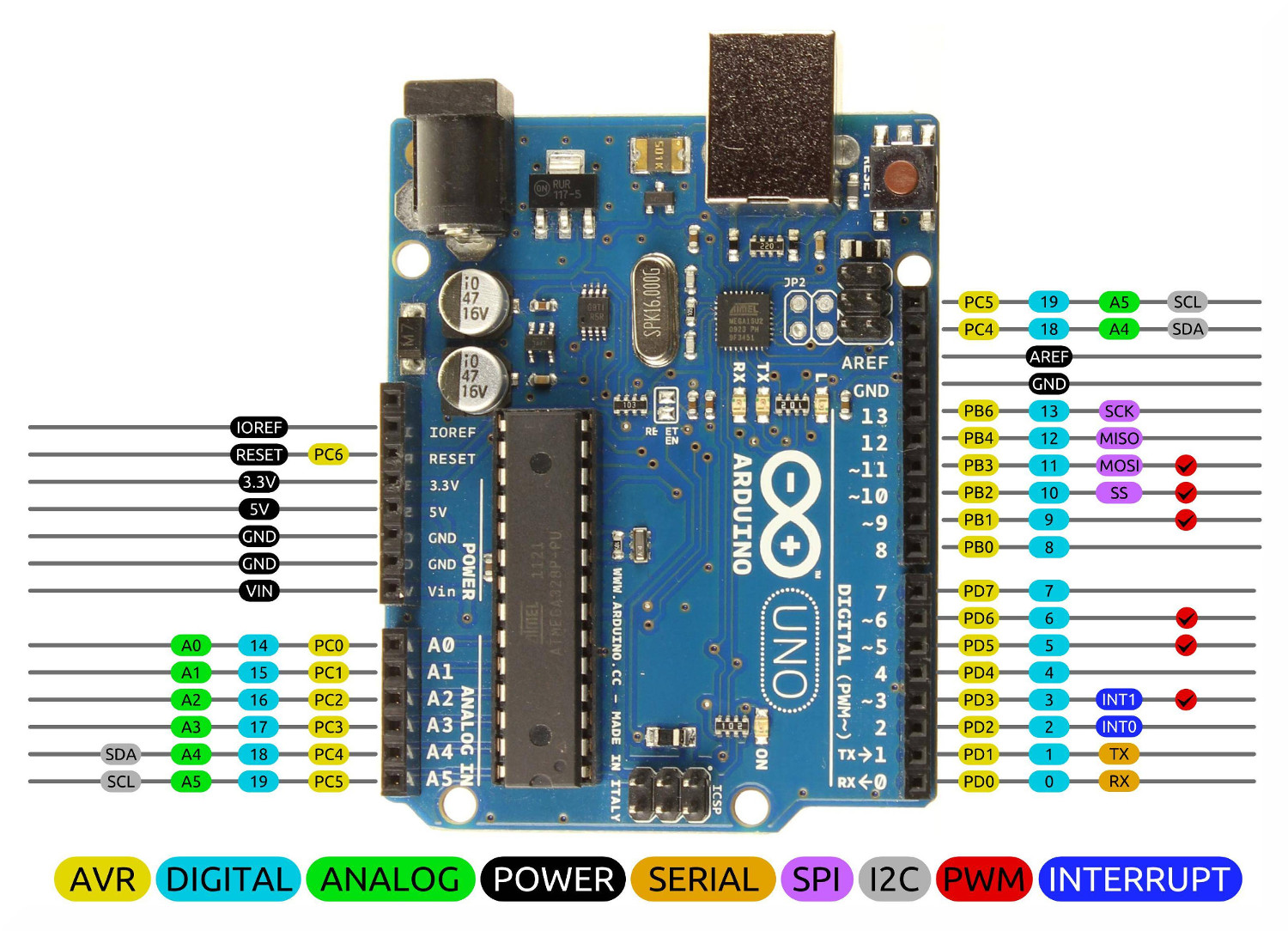
Miscellaneous
Circuit diagrams
Arduino Uno
Arduino Uno R2
Arduino Uno R3
Similar boards
- Arduino UNO QLink status: OK
- OPEN-SMART Uno R3Link status: OK
- WeMos D1 R32 ESP32Link status: OK
- Arduino Uno + WiFiLink status: OK
- WeMos D1 R2 ESP8266Link status: OK
- Arduino LeonardoLink status: OK
Add-on boards
- Retro Projekt – FDC USB Floppy Disk ControllerLink status: OK
- Preview – Arduino Motor Shield mit L298PLink status: OK
- Arduino Ethernet Board W5100Link status: OK
- Arduino VS1053 MP3 audio shield with TF cardLink status: OK
- Datenlogger Shield V 1.0Link status: Unknown
- NEO-6M GPS Logger Shield V1.0Link status: OK
- Arduino Sensor Board V5.0 (Sensor Shield)Link status: Unknown
- FunduMoto L298P High Power Motor Driver BoardLink status: OK
- Arduino Screw Terminal Board (Screw Shield 1.0)Link status: Unknown
- Arduino Multi-function Sensor BoardLink status: Unknown
Sources
https://www.arduino.cc/en/Guide/ArduinoUnoLink status: Unknown
https://store.arduino.cc/arduino-uno-rev3Link status: Unknown
https://www.zippia.com/arduino-careers-1555069/history/#Link status: Unknown
https://startingelectronics.org/articles/arduino/uno-r3-r2-differences/Link status: Unknown
| Date | Change | Author |
|---|---|---|
| 18.10.2026 | TablePress-Tabelle durch Datenblock aus dem Modell ersetzt | Suffocation |
| 08.10.2026 | Überschriften-Hierarchie korrigiert (H1→H2, Unterebenen eine Stufe tiefer) | Suffocation |
| 03.10.2026 | Rechtschreibung korrigiert: Tippfehler, Kommas, Grammatik, Groß-/Kleinschreibung Log-Liste eingefügt | Suffocation |
| 15.03.2018 | Post created | Suffocation |
Hello Stefan,
I found your blog through the ESP32 LoRa – I like it.
The Ct magazine also reports on LoRaWAN in its current issue, which I unfortunately didn't quite understand.
So, I've had an Arduino Uno and a Raspberry Pi lying around in a cupboard for quite some time, and I'd love to experiment with them, but I'm also lacking a proper, senior-friendly guide, and the time (like you!) is also an issue.
P.S. I'm also a fan of the CC2, though W. Rudolf should live somewhere around my corner (56457 Westerburg)?
Kind regards
Wolfgang
Hello Wolfgang,
Glad you liked the article. Yes, CC2 is great.
I'll buy that CT article right away. I had a quick read about Lora,
all that remains is that it's about long-distance communication, but the name itself suggests that anyway 😉
Hello
Stefan