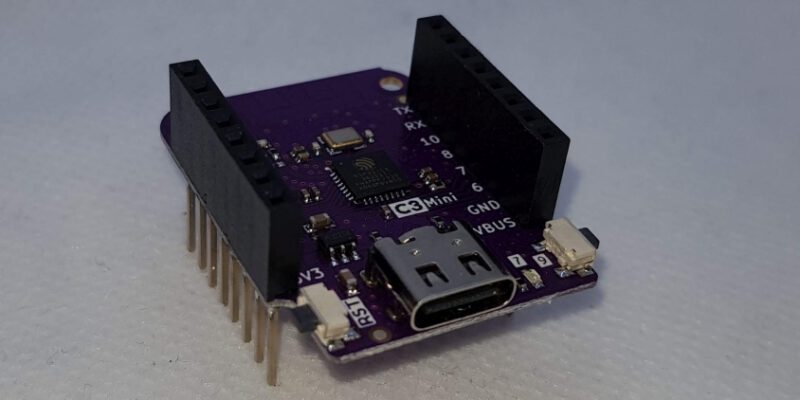
Wemos C3 Mini

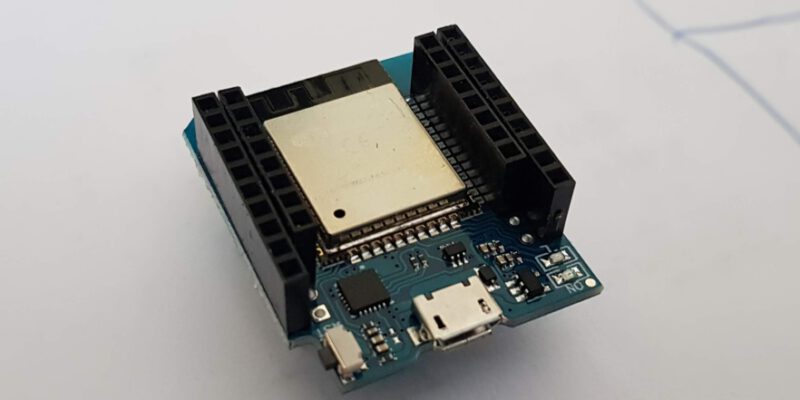
The WEMOS C3 is the latest in the D1 Mini format. A USB Micro connection, a reset button, and two built-in LEDs on the ESP are the only peripherals. In terms of its dimensions, it is rather small, with only a few pins brought out externally. However, the ESP32-C3 with its RISC-V CPU features Bluetooth 5.0. Interesting how...

Continue reading "(Wemos) C3 Mini"
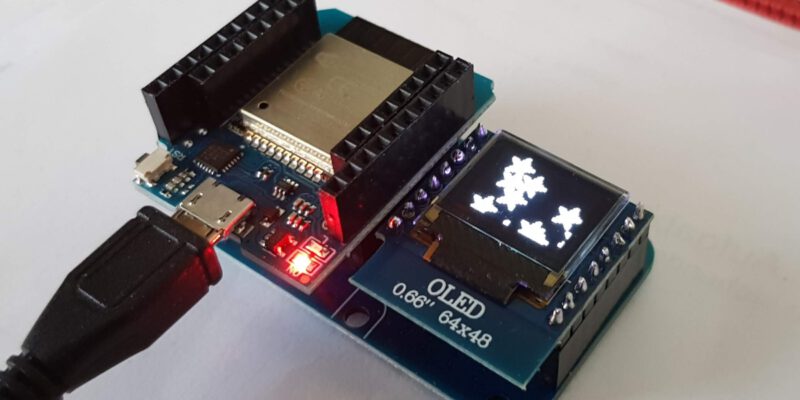
D1 Mini Shield – OLED 64×48

This add-on board provides everything needed to control an OLED display. Facts OLED Display 64x48 Pixels Description Name D1 Mini D1 ESP32 I2C Data Pin SDA D2 GPIO 4 GPIO 32 I2C Clock Pin SCL D1 GPIO 5 GPIO 25 I2C Address 0x3C 0x3C D1 Mini Shield – OLED 64x48 – Pins…

Continue reading "D1 Mini Shield – Oled 64×48"

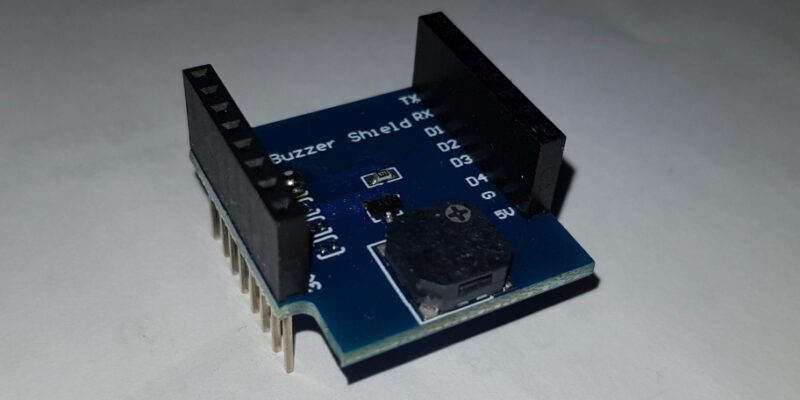
D1 Mini Shield – Buzzer (Beeper)

With the help of this add-on board, a few sounds can be coaxed from the D1 mini. Facts: A buzzer, nothing more, can be connected to the IOs D5-D8 via a solder bridge. No pre-selection was made in my case. Description: Name D1 D1 32 Input Buzzer, depending on the selected solder bridge BUZZER D5 / D6 / D7 / D8 GPIO 22/21/17/16 …

Continue reading "D1 Mini Shield – Buzzer (Pipser)"

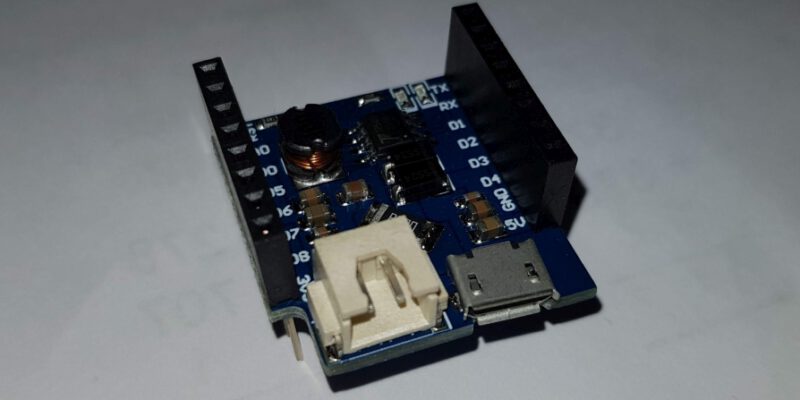
D1 Mini Shield - Battery (Replica)

This add-on board includes a LiPo charger, enabling an independent power supply for the D1 Mini. Charging is done via its own micro-USB port. Facts: Micro USB port, LiPo port (JSP PH2 2mm socket, 2 Pin), TP5410 charging IC, Blue LED - battery full, Red LED - charging. Description: Name, Pin, Solder bridge to set the maximum charging current…

Continue reading "D1 Mini Shield – Batterie (Nachbau)"
D1Mini DualBase - Front

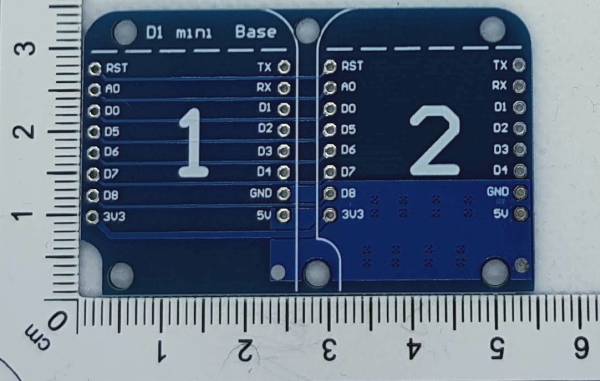
D1 Mini Shield – D1 Mini Base

Fundamentally, it's possible to stack all D1 add-on boards like the ingredients of a burger. However, it doesn't always help if the sensor, display or anything else is covered by the next burger layer. For example, temperature data can be falsified or a button can no longer be pressed. Their only function is to [provide all] pins to a...

Continue reading "D1 Mini Shield – D1 Mini Base"

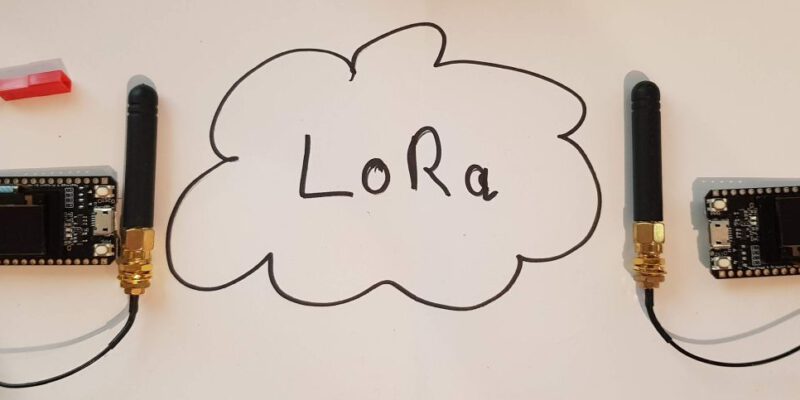
TTGO LORA32 OLED V1

I bought these LoRa boards some time ago as a double pack and forgot about them in a drawer. With more and more reports about LoRa (Long Range Radio) appearing, I wanted to try it out as well. I have documented my attempts here. There is now a version 2 of the board. Version 2 also has…

Continue reading "TTGO LORA32 OLED V1"

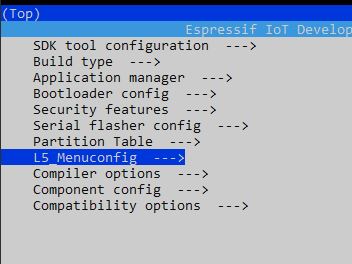
Espressif IDF – Menuconfig

One of the nice achievements of the IDF is the menu-driven configuration. What I find even nicer is that custom configuration points can be created. These are then automatically integrated into the main menu. First off: the library „esp_system.h“ is needed in the source code, otherwise it won't work. After changes to the menu, run an idf.py clean. To create such a configuration point, take...

Continue reading "Espressif IDF – Menuconfig"

Espressif IDF – Timer

A popular example in the Arduino environment is Blink. This switches an LED on and off with a short pause. We will come to GPIO actions in the next chapter; we will deal with blinking here. In the Arduino environment too, it is always advised to avoid code interruptions with delay. There are some constructs there with...

Continue reading "Espressif IDF – Timer"

Espressif IDF – Log Messages

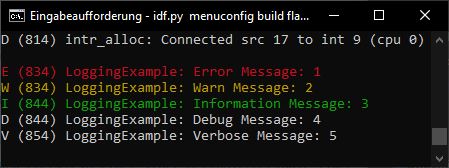
When developing on the microcontroller, it's often important to have the occasional output to gauge whether the developed code is doing the right thing. It's a shame when such outputs still burden the finished product. So that the debugging code makes it into the final product, or only to a limited extent, there are in nearly…

Continue reading "Espressif IDF – Lognachrichten"